How to Shape an Oral Story for a Rural Gathering
Shape an oral story for a rural gathering with a clear route, memorable images, and purposeful pauses, so listeners can follow and imagine the tale.
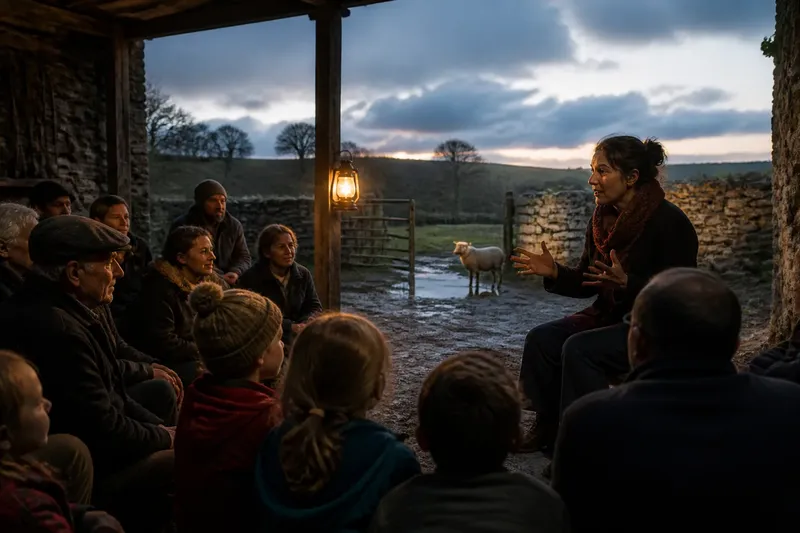
To shape an oral story for a rural gathering, give listeners a clear route and a few vivid details they can carry in their minds. Spoken tales unfold only once: a listener cannot turn back to check who opened the gate or why the lantern matters. Your choices of sequence, emphasis, and pause help the story travel from your mouth to their imagination.
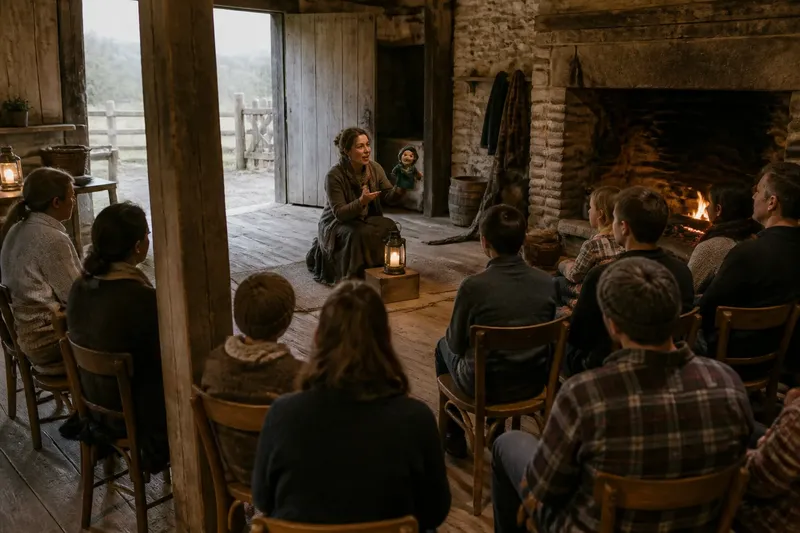
A kitchen after supper, a village hall, or a shelter where rain taps the roof can all become places for a tale. The surroundings need not become part of the plot. Start with a story that has a human want, a change, and a final action; then let the words do the work without dressing every line in a gesture or character voice.
What gives an oral story a clear shape?
A listener has to hold each event in memory as the next one arrives. Give the story a simple route: introduce the central character, show what they want, and make the change that sets events moving easy to hear. A story can still be mysterious, but its basic actions should not be hard to track.
Think of the tale as a path with a few landmarks. The character finds a gate open. A sound comes from the byre. A choice follows. Those moments give listeners something to hold on to while they picture the rest.
Keep the telling rooted in action rather than explanation. Instead of describing every tool in a shed, show the character reaching for a hook and discovering it is missing. The detail matters because it changes what happens next.
How do you choose a tale to tell aloud?
Choose material you can remember as a sequence, not merely admire on the page. Folk tales, family recollections, seasonal anecdotes, and original stories can all work. If the cast or plot is difficult to keep straight, simplify it before you tell it.
Use these questions to check the story’s route:
- Who is the story about? If the central character is not obvious, name them again before the next important action; otherwise, keep the introduction brief.
- What does the character want? If the desire gives listeners a reason to follow, keep it; if it remains vague, make the wish or problem more concrete.
- What changes? If a discovery or decision alters the character’s course, keep that turn; if nothing shifts, add a meaningful choice or trim the tale to its strongest moment.
- Which details matter to the action? If an object or place affects what the character does, include it; if it only delays the event, cut it.
- Can you say the names clearly? If similar names blur together aloud, rename one character; if each is distinct, leave them as they are.
Read the tale aloud once to catch phrases that tangle the sequence. Replace a difficult sentence with ordinary language if the meaning survives. Keep a local word when context makes its meaning clear and it gives the scene its particular character.
Say you are shaping an invented tale about a child who carries a lantern to the byre on a windy evening. The starting pieces are a child, an escaped lamb, an open gate, and a lantern. First, establish that the lamb is missing; next, let the lantern show muddy tracks beyond the gate; then have the child follow them and lead the lamb home. The resulting route has one main problem and one visible clue, while the tradeoff is that a larger cast or a long account of farm routines must wait for another story.
How should you prepare the spoken version?
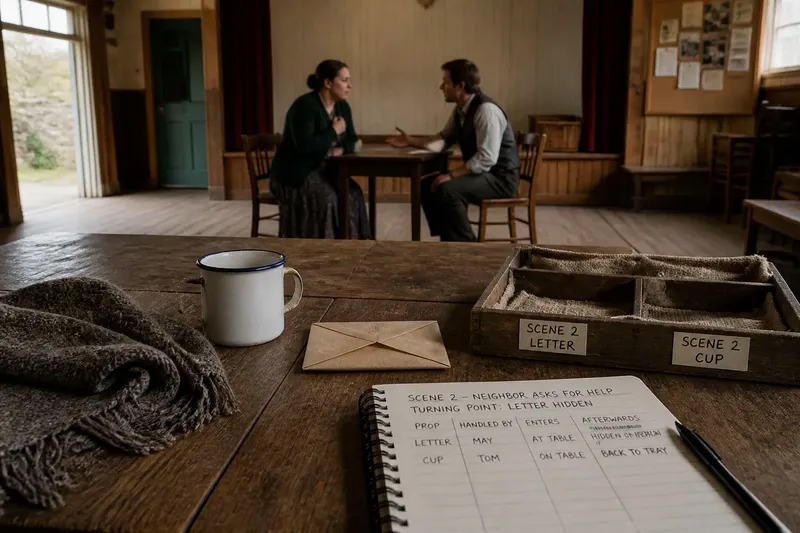
Learn the event sequence rather than memorising every sentence. Write cue words on a card—“wind, missing lamb, light, tracks, return”—and use them to recall what happens next. This leaves room for natural phrasing while keeping the story’s route intact.
Mark the turns where new information changes the character’s next move. Give each turn a clear sentence. If a gate is open, say so before the character follows tracks through it. A pause cannot replace that link; listeners need to hear what the character knows and why it matters.
Decide which sensory details earn their place. A damp sleeve or a latch rattling in the wind can make an action easier to picture. A long inventory of objects can pull attention away from the character’s immediate problem.
Keep your voice comfortable and clear. In a village hall, face the group and avoid speaking into a corner. Outdoors, choose shelter from wind if it is available; if noise makes a quiet sentence hard to hear, wait for a lull or phrase the next point more plainly rather than forcing your voice.
How do pace and pauses shape the tale?
Use an even pace for ordinary movement, then slow slightly when an image or clue needs to register. If a character spots muddy marks near a doorway, let listeners picture them before explaining what the character does. Racing through the clue can blur the story; stretching every sentence can make it feel heavy.
A pause should have a purpose. It can leave room to picture a place, signal a change of scene, or let a surprise land. It can also give you a breath. Keep less important moments moving so the story does not become a chain of stops.
Suspense and confusion are different. A short pause before an answer can invite curiosity. Before a new character appears, listeners may need the person named and their action stated plainly. Silence can sharpen a clear moment, but it cannot supply a missing connection.
Vary sentence length for the ear. A longer sentence can carry a walk across the yard; a short one can mark a decisive action. Use the contrast selectively, so the tale does not become either a list of clipped lines or a maze of winding ones.
What should you do as the story unfolds?
Stay attentive to listeners without treating every face as a verdict. A child following the action or a group going quiet may suggest the story is holding them. Several puzzled looks at the same point may suggest a missing link. If that happens, name the character and make the next action explicit.
If someone interrupts with a question, answer briefly in the story’s terms and return to the last clear event. If the answer would reveal the next turn, say that the character is about to find out and continue. With a mixed-age group, explain an unfamiliar object through what the character does with it rather than pausing for a catalogue.
Use gestures sparingly. A glance toward an imagined doorway can mark an entrance. Repeated mime or elaborate voices can draw attention away from the plot, so change your voice only when it helps listeners tell who is speaking.
What questions help you shape an oral story?
How can you tell if listeners have lost the thread?
If several people seem uncertain at the same moment, restate the last important fact and name the character’s next action. Then continue from that point instead of restarting the whole tale.
Should you memorise every word?
Usually, it is more useful to remember the sequence and key images than to reproduce exact sentences. A cue card can hold names or events that are easy to forget while leaving the spoken wording flexible.
How do you tell a story outdoors?
Use a sheltered spot when available and face the listeners. If wind or other noise rises, wait for a quieter moment or make the next sentence direct rather than straining to outshout the surroundings.
What if the story feels flat aloud?
Find the moment when something changes and make that action easier to follow. The trouble may be an unclear want, a missing connection, or too many details before the event begins—not a lack of dramatic delivery.
How can you refine the tale after telling it?
Ask one focused question, such as, “Was there a moment when you weren’t sure who was speaking?” or “Which part was easiest to picture?” If a listener points to a confusing transition, clarify that link in your notes rather than adding explanation everywhere.
You can also note where you rushed, where a pause felt natural, and which phrase was hard to say. Treat these as clues for shaping the next telling. Keep what helped listeners follow the events; remove a flourish that competed with them.
For an oral story at a rural gathering, the useful question is not how much you can perform, but what listeners need in order to imagine the next turn. A clear route, a few telling details, and a well-placed pause leave room for the audience to build a world of their own.