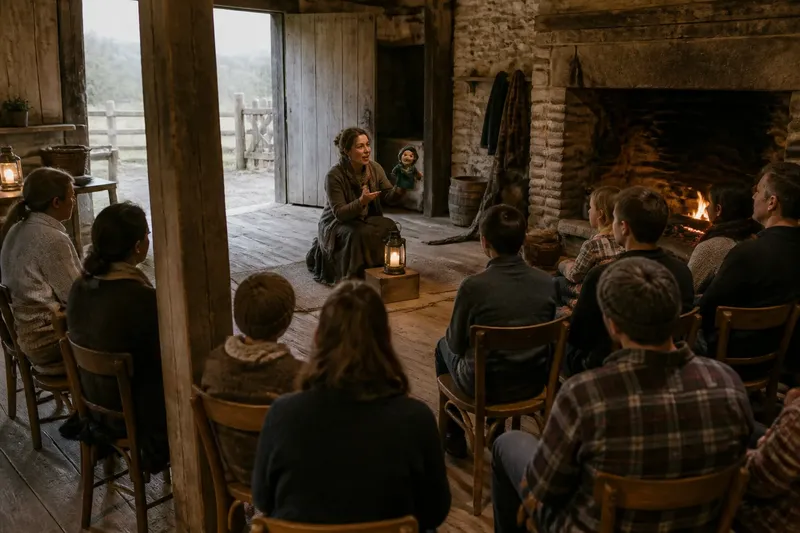
Choose Props That Give a Rural Scene Its Turning Point
Choose props for a rural performance that clarify the scene’s turning point, give performers purposeful business, and keep rehearsals and backstage handoffs orderly.
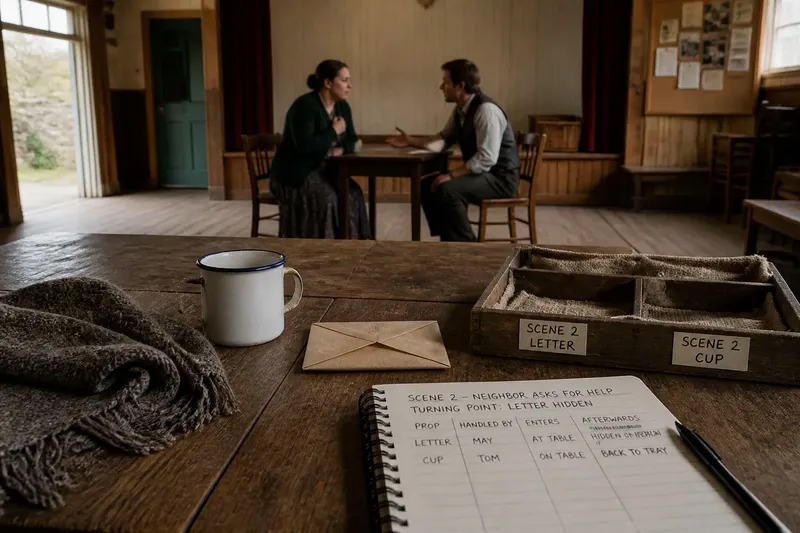
A prop table for a performance works best when every object serves a visible moment in the scene. In a village hall, a folded letter passed across a plain table can carry more dramatic weight than a roomful of convincing household clutter.
Choose props for what they let the performers do: hide a message, offer help, refuse a request, or mark a change in a relationship. Then give each useful object a clear place before and after its moment. This keeps rehearsal focused on the action rather than on managing an inventory.
Which objects change the action?
Start with the scene’s turning point. Write down what changes, then identify the object—if any—that makes that change happen. A key might prevent someone from leaving; a letter might reveal a secret; a mug might make an offer tangible when a character accepts or rejects it.
Separate objects that actors handle from background dressing. A bench can establish a waiting place without needing to be tracked like a hand prop. A shawl becomes an active prop if a performer uses it to conceal something or signal a change. The distinction helps you focus rehearsal time on objects that affect the action.
For each active prop, jot down its job in a few words: “letter hidden,” “key handed over,” or “mug refused.” If you cannot name a moment when it matters, keep it off the working table until the scene gives it a purpose.
How do you choose a clear, manageable prop?
Choose an object that is easy to handle and distinct from other objects in the scene. A folded envelope gives a performer a defined shape to conceal; a loose scrap can crumple or disappear among other papers. A plain enamel mug may read more clearly than several similar containers gathered on the table.
Consider the work the object creates. A prop that must be carefully opened, folded, or reset can interrupt a line if that business is not part of the character’s action. Simplify the handling, use a sturdier substitute, or let the performer communicate the same choice with a gesture.
Say you are staging a scene in which a neighbor asks for help, and the other character hides a letter before it can be read. Your starting point is an imagined prop list of a basket, two cups, a shawl, a tin, and a letter. You remove the basket, shawl, and tin because they do not affect the exchange, and keep one cup only if the actor uses it to delay. Then you rehearse the concealment with a folded envelope and watch whether the hiding action remains clear without the extra objects; if the cup adds no meaningful delay, remove it too. The resulting choice is a simpler scene, with the letter as its unmistakable turning point.
How should props be tracked through rehearsal?
Keep a short prop list beside the script. For each item, note who handles it, when it enters the action, and where it goes afterward. Make decisions as the scene develops rather than collecting every object mentioned in the dialogue.
- At the read-through: Mark each object mentioned or handled. If the script gives it an active moment, add it to the prop list; if it is only part of a passing description, leave it off the table for now.
- At blocking rehearsal: Record what performers actually touch, pass, hide, or move. If an object changes the action, keep it active; if it never affects a choice or movement, test the scene without it.
- With stand-ins: Use an empty cup, a cardboard envelope, or a folded scrap of cloth. If the performer can handle the stand-in smoothly, keep the design simple; if the action becomes awkward, alter the object or remove the business.
- After a run-through: Ask which object made the turning point easier to follow. If one prop distracts from the action, simplify or cut it; if removing one makes a necessary choice harder to understand, retain it and clarify its use.
- During scene changes: Assign each active prop a return place, such as a labeled tray. If an item is difficult to find or reset, give it a clearer location; if it is not needed in the next scene, store it away from the working area.
- Before a performance: Check the prop list against the items on the table. If a listed object is missing, find or replace it before the scene; if an unlisted object is taking up space, remove it unless the performers have a defined use for it.
A lively scene may need several props because passing and sharing them is the action. A quiet exchange may need only one. Judge the collection by whether each item gives performers a purposeful task and supports the scene’s change.
How can the prop table support a smooth handoff?
Give every active prop a consistent home: a tray, a marked patch of cloth, or a separate box for each scene. Put objects back in the same place after use, and keep spare dressing away from the working area. A performer should be able to find a letter or key without sorting through unrelated belongings.
If two props look alike, separate them by scene or mark their containers discreetly. Note who resets each item and when it must be ready. A simple arrangement that reflects the performance’s sequence is easier to maintain than a display arranged to look like a real room.
Keep the setup suited to the venue. In a village hall, a low-key table near the entrance may be all the crew has available; in a barn or a community room, a labeled box can serve the same purpose. The important thing is that the prop is ready for its next cue and does not become a distraction during the scene.
What questions settle a doubtful prop?
What does this prop change in the scene?
Name the choice, relationship, or action it affects. If you cannot identify one, set it aside and rehearse without it.
Can the performer handle it as part of the character’s action?
Watch whether the object supports the movement or makes the performer fumble. If handling breaks the moment, simplify the prop or remove that business.
Does the prop need a particular material or appearance?
Choose a material that suits the action and the setting, such as a sturdy envelope for repeated handling. If the material adds no useful distinction, use a simpler substitute.
Where does it go after the scene?
Give each active object a return place and a person responsible for resetting it. If the handoff is unclear, assign a location before the next run-through.
When does extra dressing help the scene?
Keep background objects when they establish a place the action depends on or give performers useful movement. A bench can make a waiting scene feel grounded; a coat placed by the door can signal that someone has arrived. But do not turn every familiar detail into a hand prop that must be handled and reset.
For a rural scene, one well-chosen object can suggest a kitchen, a shed, or a gathering after work without recreating the whole space. The prop table for a performance should support that choice: each active object has a job, a performer who knows its cue, and a place to return to. When those responsibilities are clear, the props can recede and the scene’s human choices can take the lead.