A Circle of Chairs or a Loose Row?
Compare a circle of chairs with a loose row for a rural performance, then choose a setup that fits the story’s audience role, playing space, and cues.
For a rural performance, a circle of chairs turns listeners toward one another, while a loose row gives everyone a shared direction. Choose by asking what the story needs from its audience: a visible community, or a clear view of one playing area.
That distinction matters more than whether a barn or kitchen looks tidy. A storytelling circle invites people to notice each other’s reactions; rows help a performer control a sequence of images, gestures, or entrances. You can also combine the two when a tale asks listeners to watch closely and join in at particular moments.
What does a circle make possible?
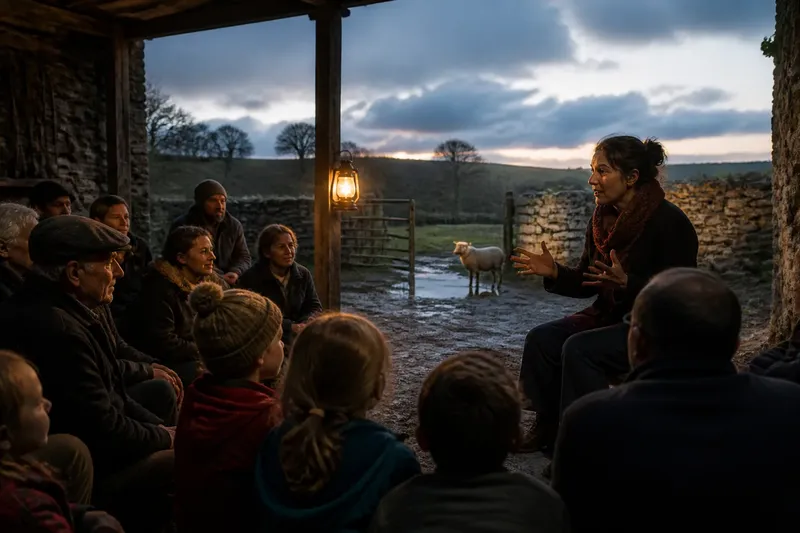
A circle suits a story that depends on shared response. Listeners can see the storyteller and one another, so laughter, a hummed refrain, or a spoken answer can travel around the group. The audience’s reactions become part of the event rather than a sound coming only from the dark.
Keep the center available for the action. A storyteller might move into it to become a character, set down a lantern, or invite a volunteer to add a sound. Leave an opening in the ring so the performer and any willing participant can enter without squeezing between knees.
A closed circle can make visual storytelling awkward, though. People opposite each other may block the center, and a low puppet or small prop can disappear behind shoulders. If the central action is subtle, open the ring into a broad horseshoe or turn the chairs toward a single playing spot.
When do loose rows serve the story better?
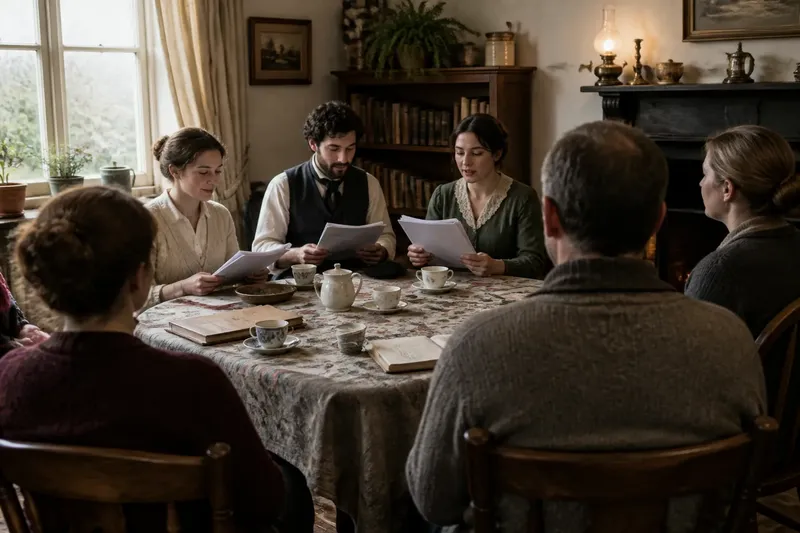
Loose rows give a performance a clear front. They work well for a monologue, a shadow story against a sheet, or a puppet scene on a table. Everyone has a similar direction of attention, and the storyteller can place an object where the audience is most likely to see it.
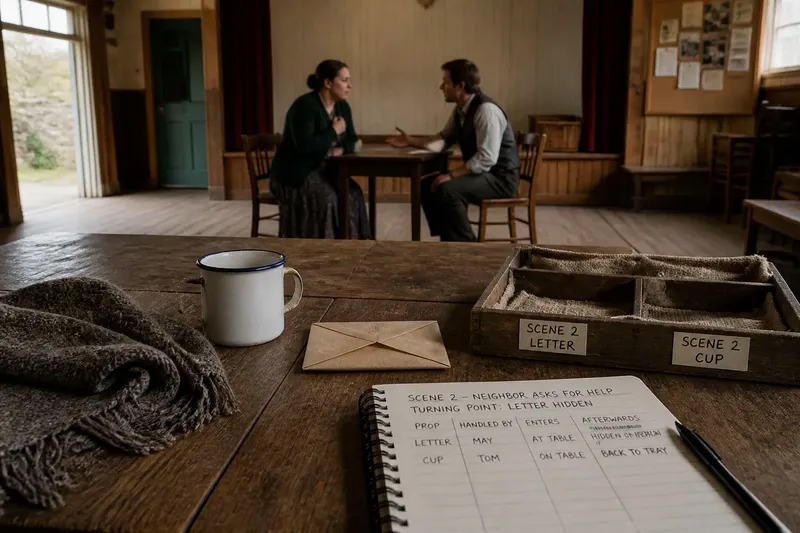
Rows also help a performer build a sequence: a character enters from a doorway, crosses toward a table, then turns to address the listeners. Rather than circling the action, the audience watches the same progression. Break a long line into short angled groups if a post, stove, or farmhouse table interrupts the view.
A row does not have to feel like a formal recital. Angle the outer chairs slightly inward, leave an aisle for late arrivals, and let the playing area sit at floor level if the story calls for closeness. The useful question is not whether the chairs form a perfect line, but whether the arrangement supports the performance’s direction.
How can you choose between a circle and rows?
Which arrangement suits a story with audience responses?
A circle or horseshoe makes it easier for listeners to see when the storyteller offers a cue and to hear one another’s replies. Choose rows instead if the responses happen at a fixed moment and everyone needs to watch a prop or gesture first.
Which arrangement helps a puppet or small object stay visible?
Rows usually give a small playing surface a more consistent view, especially when the puppet stays on a table. If you prefer a circle, open it toward the action and check the view from seats on the far side.
Can you mix a shared feel with a clear front?
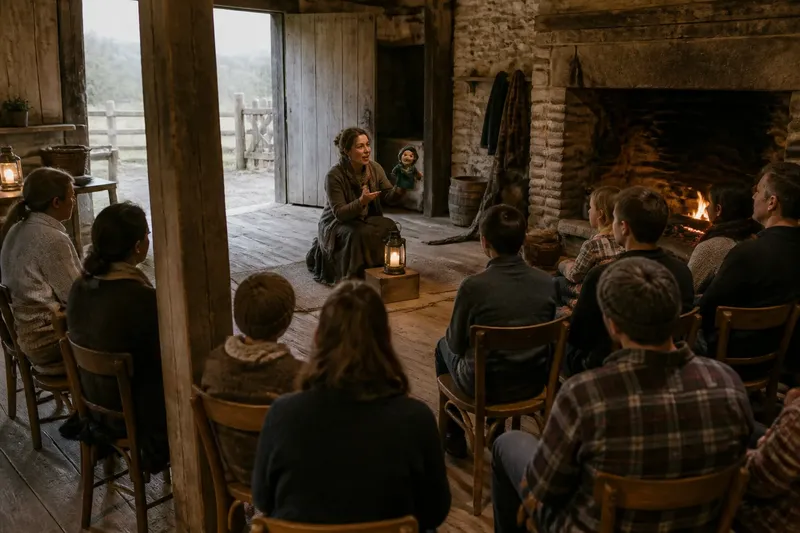
Yes. A horseshoe keeps listeners in one group while directing their attention toward a defined playing area. It is a useful middle ground for a tale with a focused scene and occasional audience participation.
What if a post or doorway cuts across the view?
Arrange chairs around the obstruction rather than preserving symmetry. Two short angled rows or a shallow arc can give listeners a better view and leave a route through the room.
What should you check before inviting people in?
Walk through the performance as if you were sitting in the least convenient seat. Check the view of the storyteller’s face, hands, and props; then confirm that the performer can move and that listeners can reach their seats without crossing the playing area.
- View of the central action: Sit behind the tallest chair or nearest post. If the performer or prop disappears, move that seat to the edge; if the view is clear, keep the arrangement.
- Audience role: Identify whether listeners answer, sing, or mainly watch. If people need to respond to one another, choose a circle or horseshoe; if they need to follow a visual sequence, choose rows.
- Performer’s route: Trace the entrance and any planned movement. If a chair blocks the route, shift it or open an aisle; if the path is clear, leave the playing area as planned.
- Small props and puppets: Place the object at its intended playing height and check from the far seats. If shoulders hide it, use rows or move the object into a clearer sightline; if it remains visible, retain the shape.
- Access to seats: Check the path from the door and leave a choice of places near an edge. If someone would need to step through the action or crowd, widen the route or reposition chairs; if access is clear, keep the entrance open.
- Sound direction: Listen from the seats nearest an open doorway or noisy appliance. If the storyteller’s voice competes with the noise, turn those chairs toward the performer or choose a quieter playing position; if speech is easy to follow, leave the direction unchanged.
These checks are about the story’s particular demands, not a perfect floor plan. One blocked puppet or a difficult entrance can matter more than a room that looks slightly uneven.
How can you work around an awkward rural room?
Start with the room’s fixed features: a broad post in a barn, a kitchen table that cannot be moved, or a doorway people will use during the gathering. Treat them as boundaries for the playing area, not obstacles to hide with a neat arrangement.
Imagine a storyteller has a hand puppet, a wooden post stands between the door and hearth, and the story includes one call-and-response. The host places three short rows on the clear side of the post, angles the end chairs toward the storyteller, and leaves a gap beside the hearth for the response. The resulting tradeoff is straightforward: listeners get a shared view of the puppet, while the call-and-response feels less face-to-face than it would in a circle. If seeing neighbors respond matters more than the puppet’s detail, a horseshoe may be the better choice.
For a story that changes shape, make a small change at a natural pause. Begin in rows for a focused telling, then invite listeners to turn their chairs inward for a shared refrain. Move only the chairs needed; a simple transition keeps attention on the performance rather than on furniture.
What does the arrangement tell listeners?
Chairs quietly set expectations. A circle suggests that people may answer or contribute; rows suggest that a performer will lead the sequence. A horseshoe offers a clear front without making the audience feel entirely separate.
For a circle of chairs or a loose row, match the setup to the story’s main pleasure: watching a carefully placed image, or sharing a response with neighbors. Then check the view and the route from the seats people are most likely to choose. That small pause before the gathering begins can make the first invitation feel natural.